Artificial intelligence is often discussed in terms of models, benchmarks and capabilities. Far less attention is paid to the physical infrastructure that makes inference possible.
As AI becomes embedded in business operations, public services and government, inference availability is becoming as important as model performance. Every inference request ultimately depends on a physical supply chain of semiconductor fabrication, specialised accelerators, networking, electricity, cooling and secure datacentres. That infrastructure is becoming strategically important in its own right.
Recent reports of strikes affecting an AWS datacentre in Bahrain serve as a reminder that AI services ultimately rely on physical assets. While hyperscale cloud platforms are engineered for resilience, disruption to compute, storage or supporting infrastructure demonstrates that inference availability cannot be assumed.
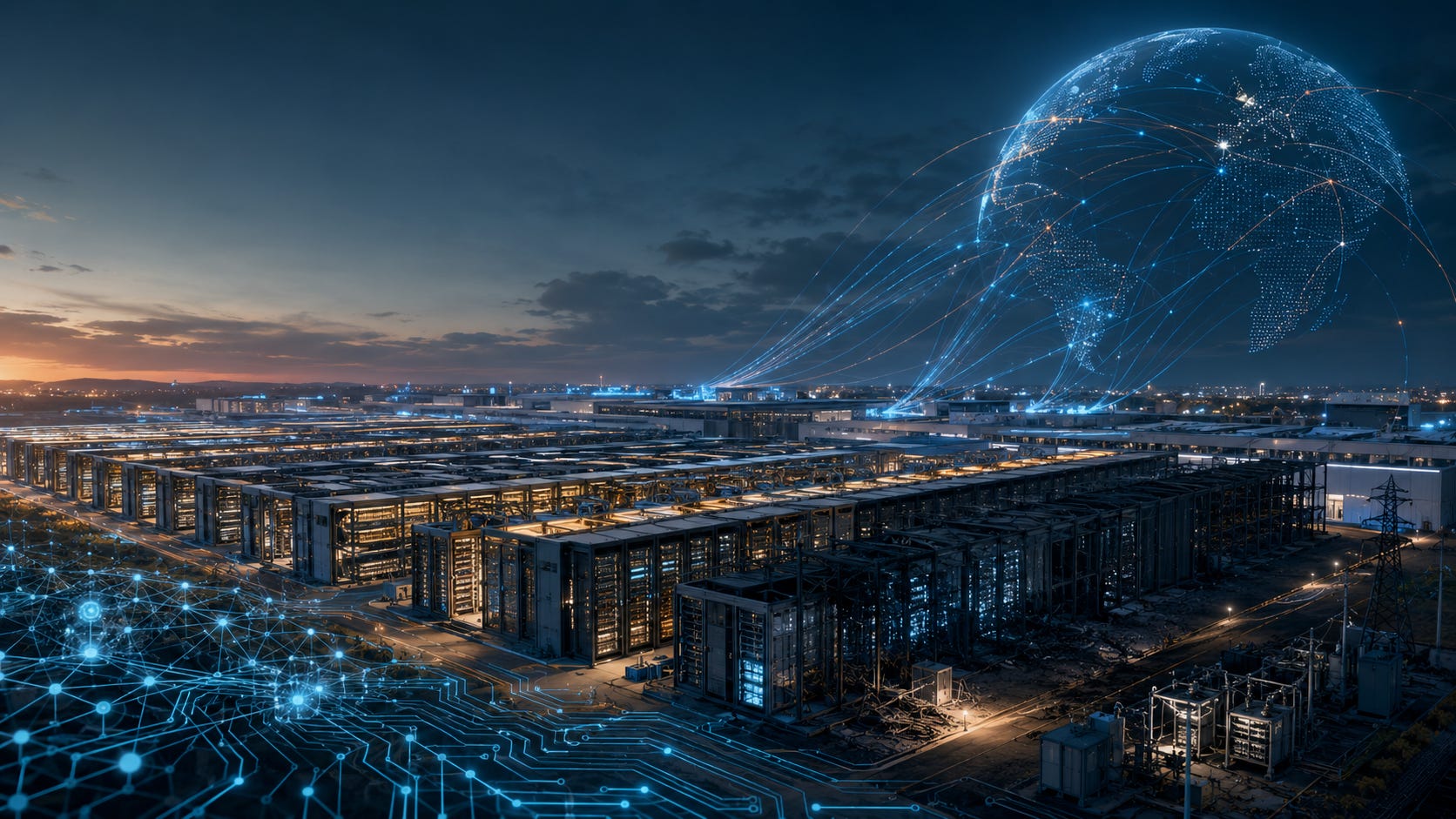
AI compute is inherently scarce
Modern inference depends on dense clusters of GPUs and specialised AI accelerators. These systems consume significant rack space, electrical power and cooling capacity and remain substantially scarcer than conventional cloud compute. Apollo Global Management covers this beautifully in their piece on Compute shortage.
Unlike general-purpose virtual infrastructure, spare inference capacity is often unavailable. Recovering from a regional outage may require accelerator capacity that simply does not exist elsewhere.
As demand continues to outpace supply, inference capacity has become a strategic resource rather than simply another cloud service.
Specialised silicon increases concentration risk
The hyperscalers are increasingly complementing commodity GPUs with proprietary AI silicon. AWS has invested in Trainium and Inferentia, Google continues to expand deployment of Tensor Processing Units (TPUs), Microsoft has introduced Azure Maia, while Meta is deploying its Meta Training and Inference Accelerator (MTIA) architecture internally.
These accelerators deliver significant improvements in cost, efficiency and performance, but they also increase infrastructure concentration. Inference stacks become tightly coupled to proprietary compiler toolchains, runtimes and optimisation frameworks. Workloads engineered around Inferentia, TPUs or other NPUs cannot necessarily be redeployed rapidly onto alternative hardware without engineering effort or performance degradation.
Capacity constrained on one accelerator platform cannot always be substituted with another. As AI ecosystems become increasingly vertically integrated, hardware diversity improves efficiency but reduces operational flexibility.
Datacentres become strategic infrastructure
The concentration of hundreds of thousands of AI accelerators within relatively few hyperscale facilities creates strategic points of failure.
Individual AI datacentres increasingly contain billions of pounds’ worth of specialised infrastructure supporting countless downstream services. Their importance now extends well beyond the organisations that own them.
Just as electrical grids, ports, airports and telecommunications networks underpin modern economies, hyperscale AI infrastructure is becoming part of the strategic fabric on which governments, businesses and citizens increasingly depend.
Sovereign AI clusters become national assets
Governments are increasingly recognising that access to sovereign AI capability is a matter of national resilience.
Many countries are investing in domestic GPU and NPU clusters to support public services, defence, healthcare, research and industry without relying exclusively on foreign hyperscale providers. Sovereign inference capability is rapidly becoming another category of critical national infrastructure.
As AI becomes embedded across government and industry, the availability of domestic accelerator capacity becomes a strategic capability in much the same way as energy security, telecommunications and satellite infrastructure.
Infrastructure failures extend beyond compute
Accelerators represent only one layer of the AI supply chain.
Large-scale inference depends equally upon resilient electricity supply, cooling systems, high-capacity networking, backup generation, fuel logistics and physical security. Failure in any one of these supporting systems can remove inference capacity even when the compute hardware itself remains operational.
The largest AI clusters now consume hundreds of megawatts of power and enormous quantities of cooling capacity. Their operation increasingly depends upon infrastructure traditionally associated with utilities rather than information technology.
Geography shapes resilience
The next generation of AI datacentres requires unprecedented levels of electricity, cooling and water. These resource requirements increasingly determine where new facilities can be built.
North American datacentres generally benefit from mature infrastructure, extensive physical security and comparatively stable geopolitical conditions. However, access to affordable power, transmission capacity and water is finite, encouraging continued investment in regions able to offer abundant energy, favourable economics and strategic connectivity.
The Gulf states, including the United Arab Emirates and Bahrain, have emerged as attractive locations for major AI infrastructure investment because they can support large-scale power availability and ambitious digital infrastructure programmes.
However, geographic diversification also changes the overall risk profile. Infrastructure located in regions experiencing greater geopolitical tension may face elevated risks from regional conflict, supply-chain disruption or physical attack. As global AI capacity expands, availability increasingly depends upon infrastructure operating under very different security environments.
Physical threats are no longer theoretical
As AI infrastructure becomes more valuable, it also becomes a more attractive target.
Natural disasters, industrial accidents, sabotage and military conflict have all demonstrated the vulnerability of critical digital infrastructure. In regions experiencing geopolitical instability, datacentres are increasingly exposed to kinetic risks that extend well beyond traditional cybersecurity planning.
Recent events illustrate that disruption to physical infrastructure can rapidly translate into reduced digital capability. AI availability is ultimately constrained by the resilience of the facilities in which inference is delivered.
Public perception can become an operational risk
Not every infrastructure threat originates from sophisticated adversaries.
The arson attacks against 5G telecommunications infrastructure during the COVID-19 pandemic demonstrated that misinformation can motivate direct attacks on critical infrastructure. False narratives translated into real-world disruption.
AI datacentres are already attracting increasing scrutiny over electricity demand, water consumption, environmental impact and land use. These are legitimate public policy debates that deserve careful consideration. However, history demonstrates that infrastructure associated with wider societal concerns can become a symbolic target when misinformation, conspiracy theories or extremist narratives take hold.
The precedent already exists. Critical digital infrastructure has previously been attacked because of false beliefs about the harm it was perceived to cause. As AI infrastructure becomes more visible and more politically significant, operators should recognise that physical security increasingly extends beyond perimeter fencing and access control to encompass public trust and societal resilience.
The economics of strategic infrastructure
Every inference request depends upon a globally distributed network of semiconductor manufacturers, specialised accelerators, networking equipment, electricity, cooling systems and secure datacentres.
Every component introduces operational, geopolitical and physical risk.
Those risks are not theoretical; they are already influencing investment decisions. Operators must account for physical security, insurance, contingency capacity, redundancy and resilience as part of the cost of delivering inference. Infrastructure located in regions exposed to elevated geopolitical risk may also attract higher financing costs and significantly higher insurance premiums as insurers reassess their exposure to conflict and disruption.
These costs do not remain with infrastructure providers. They are ultimately reflected in the economics of AI.
For consumers, this may appear as higher inference prices, regional pricing differences, reserved-capacity premiums or constrained availability during periods of supply disruption. For investors and operators, it is reflected in higher capital costs, increased operational expenditure and more complex risk management.
The discussion around AI has largely focused on algorithms and semiconductor supply. Increasingly, it should focus on infrastructure.
AI is no longer simply a software capability delivered from the cloud. It is becoming strategic infrastructure—dependent upon physical assets, natural resources, secure supply chains and geopolitical stability. As societies become more reliant on AI, the resilience, location and protection of that infrastructure will increasingly determine not only the availability of intelligence, but also its cost.
About Anera
Our goal is to continue to stay on top of the economics of inference. Every new model moves markets. We are lucky that we get to work with teams at the bleeding edge of frontier open source inference arming them with capital and compute to keep pace with the surging demand for tokens. If you are in the business of inference and need frontier compute, feel free to reach out!
[email protected]
Thanks for reading Insights by Anera! Subscribe for free to receive new posts and support my work.