On Monday I had the chance to make a presentation to a room full of Defi mechanism designers, hosted by Pantera, Bull Moose and Silicon Data in New York. For those of you that don’t know, Anera is not a new company. We started off in the defi orderflow trenches, specifically in a little hivemind called “intent-centric orderflow”. If you already know what that means, fantastic. If you do not, you do not need to. If you feel like you must, here is a youtube video that you can watch. The TLDR of our job was to basically compete to enforce NBBO for defi orderflow and aggressively design away any value that leaks to arbitrageurs. Funnily enough, we pivoted out of the DeFi and MEV trenches all the way into the financialisation of compute, thinking we’d never really be surrounded by a bunch of mechanism designers again. Yet there I was, new subject matter, same old crowd!
Compute market structure has garnered a lot of interest, and we’re seeing a lot of crossover of talent between crypto and compute. I believe people from crypto who studied order flow have a unique mental model for understanding the inference business, OpenRouter and token factories.
No MEV gathering is really complete without debates, spicy takes or gimmicks. Despite Danning’s best efforts, she still couldn’t get all of us to participate in an Oxford-style debate and wear suits, albeit the room had a healthy smattering of folks who actually decided to show up in one.
I’ve written this as a broader expansion of my presentation, which was a 10-minute talk sandwiched between Tarun Chitra from Gauntlet and Robot Ventures, and Jonah Burian from Blockchain Capital. Funnily enough, Tarun, Jonah and I all had a ton of overlap, not about the current state of the market, but the gaps in it. None of us exchanged notes or slides beforehand, and somehow we independently arrived at similar conclusions. In general, I enjoyed presenting my ideas, sharing common threads and catching up with old friends.
Anywho, onto the meat and bones. The question atop everyones mind was simple: is compute a commodity?
The TL;DR: it behaves like one, but it isn’t financed like one. And if it isn’t financed like one, it isn’t one yet.
So this is a yes-and-no essay. Five reasons it’s a commodity. Three reasons it isn’t. And what has to exist to close the gap.
Recap: a tale of two computes
The immediate recap was my last essay, A Tale of Two Computes, where I articulated the difference between the two compute markets.
The labs and the hyperscalers. In the compute market linked to the labs and the hyperscalers, the vast majority of the risk sits on the balance sheets of very strong, well-capitalised players. And that risk is getting traded and transferred through credit default swaps.
There are cracks in this model. A tremendous amount of risk now sits on these balance sheets, and the CDS spreads are telling us what the market thinks about it.
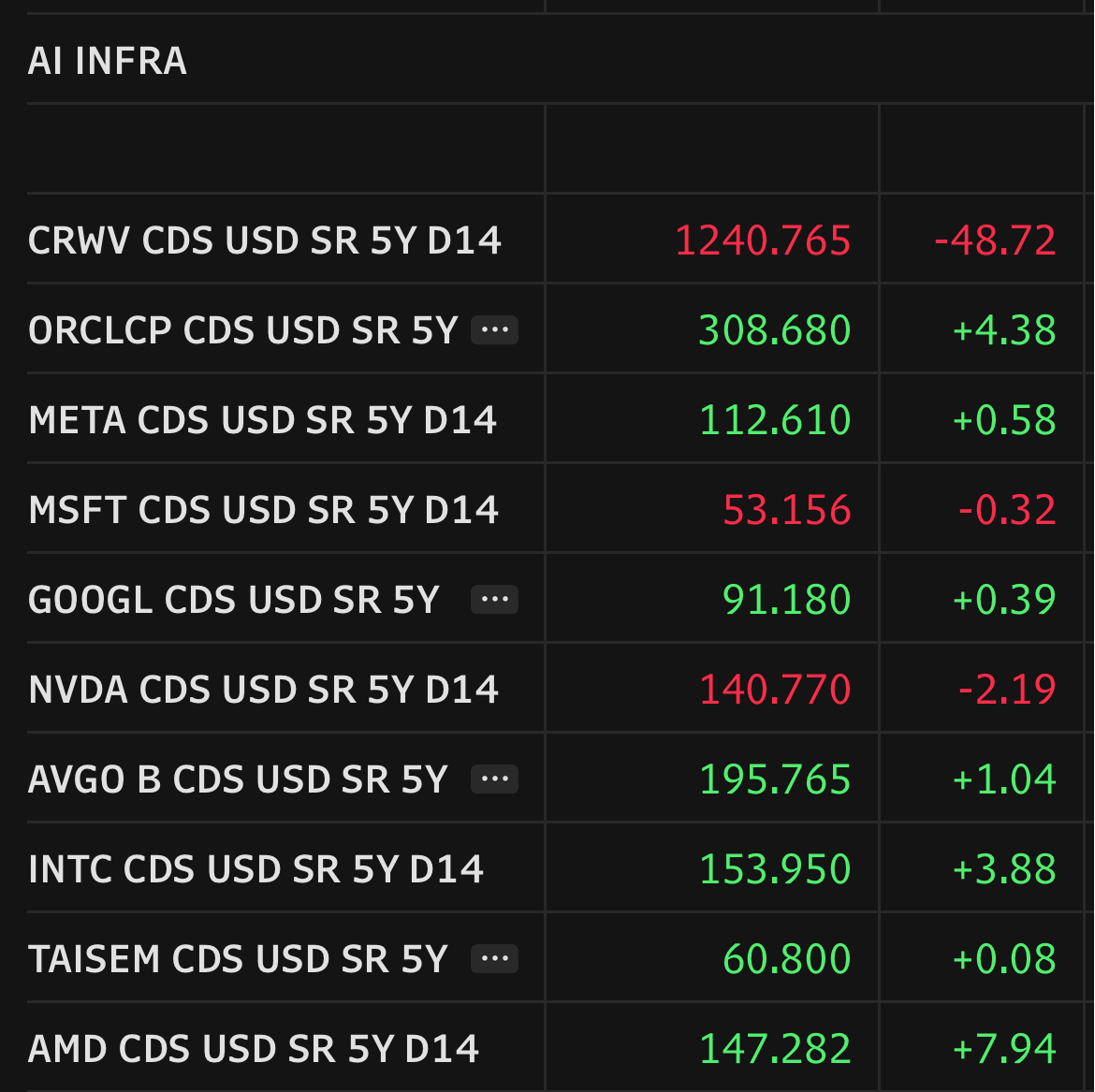
CoreWeave is now officially in free fall on its CDS. At twelve hundred, almost thirteen hundred basis points, it could be the trade of a lifetime for people with the balls to go long, or an incredibly stupid thing to do. The interesting thing is that there’s stress across the book. The semiconductor firms themselves, including Nvidia, are now seeing CDS spreads consistently north of 100 bps. NVIDIA CDS at 140bps implies that the insured yield on NVIDIA is now well below the US 10 year. In a public market that looks for safe haven, unsecured notes from the buildout will have to clear a much much larger hurdle rate. That’s cause for concern. Circular financing, along with backstops, puts an emphasis on whether these extremely well-capitalised, extremely profitable companies, whose cash flows have thinned out as they pour capital into the build-out, can keep tapping the bond markets. Bond markets are counterparty-driven, so the most appropriate way to transfer this risk is credit default swaps.
However, as I mentioned previously, for this market, compute and AI is a strategic asset. Compute is not price sensitive. It is a large bilateral market, where scale is the product. The stress will live on the operators recruited to execute on behalf of hyperscalers. CRWV, ORCL, Crusoe and other Neoclouds will have to warehouse a good chunk of public markets risk to stick the landing on an insatiable compute hamster wheel that the frontier labs and hyperscalers will refuse to get off. Nvidia will do its best to see these companies succeed by investing and backstopping them wherever they can. While these new neoclouds could be collateral damage in the imprecision, volatility and capital scarcity that will inevitably occur before this build out spits out some free cashflow, Hyperscalers and Semis firms will get bailed out by the United States of America. They are just too integrated to the national interests and the dollar.
All of this to say, nobody in this market is hedging the GPU hour.
Open-source inference. The second market powers the infrastructure behind open-source AI. The general consensus is that there’s no meaningful investment-grade counterparty behind this infrastructure, and so compute is increasingly a commodity here. At the top, this market consists of the largest inference platforms - Baseten, Together AI, Fireworks and Modal. In aggregate market cap, these companies now represent over $120bn. Overall, this market segment is about $250bn and growing fast. The compute needs of this market will increasingly be served with bare metal bandits - neoclouds operating sub 25MW footprints, often in 1-2.5MW increments. However, the offtake is massively capital efficient, and there are still many many companies (start ups, Neolabs) who want compute but cant access compute outside of 3Y offtake requiring 20-30% of TCV. This market will be served by a growing cohort of compute commodity traders. Just like in Oil, these actors will aim to lease clusters on 3Y and sell them back to other customers on shorter durations, ranging from On demand with VM to 1m-1Y tenors bare metal.
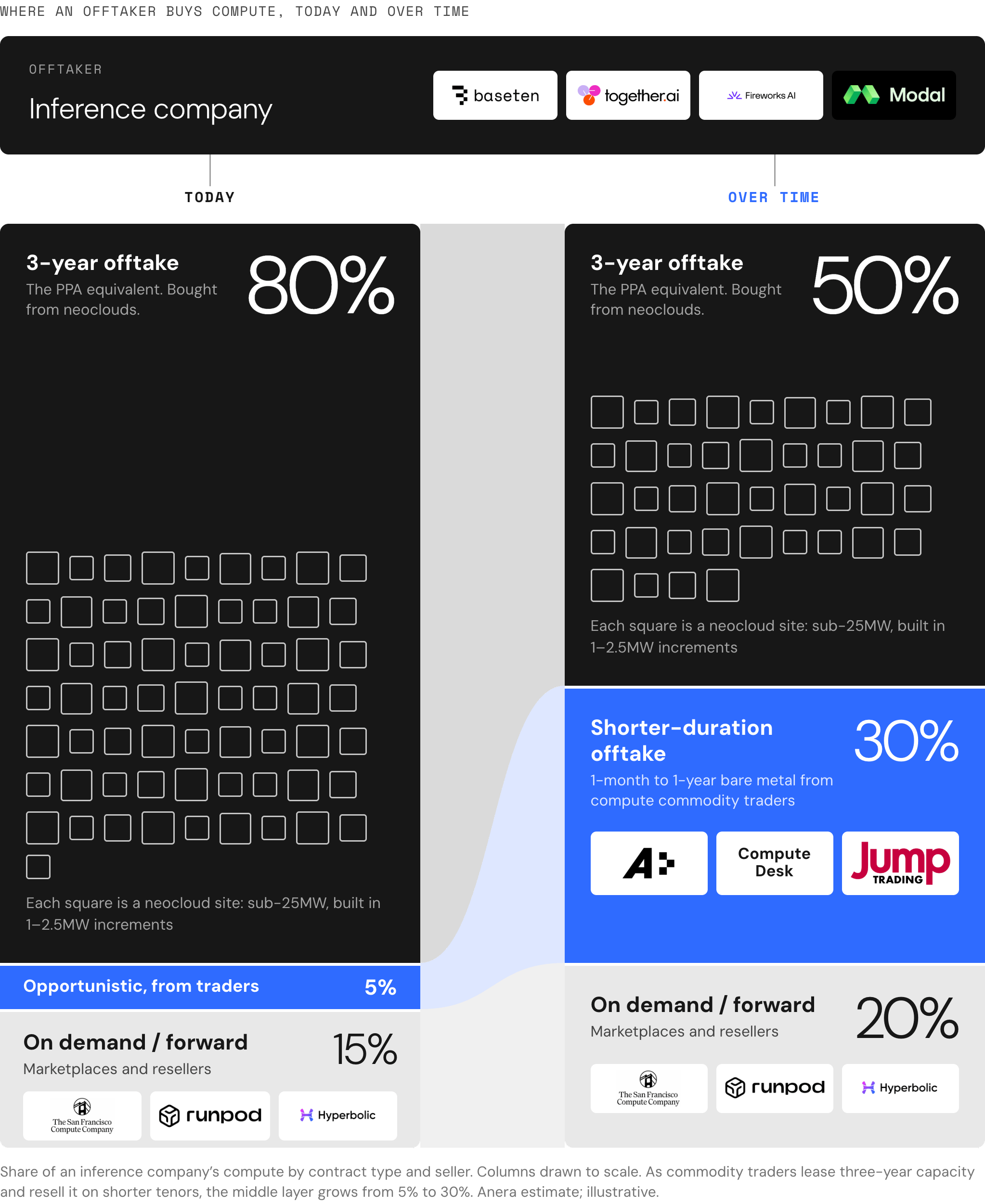
This essay isolates that second market and decomposes the arguments for whether compute is a commodity.
Yes, compute is a commodity
Into the meat and bones of the argument. Yes, compute is a commodity, and here are the five reasons why:
It has power’s physics and oil’s complexity.
It’s bought like a commodity.
It’s sold like a commodity.
Participants behave like rational market participants.
Markets are getting more rational as arbitrageurs enter.
1. Power’s physics, oil’s complexity
Power’s physics: it can’t be stored. The immediate, intuitive point is that an idle GPU-hour is gone forever. You can’t put it in a tank. You can’t carry it into the next quarter. We haven’t figured out what the batteries of compute look like, so there are no storage properties to meaningfully define a cash-and-carry trade.
But this is where the analogy breaks a little. Compute isn’t grid-bound the way power is. In theory it’s a single, unified global endpoint, constrained only by regulation, availability or workload specificity. So the perishability exists, but the delivery complexity doesn’t. What this implies is that compute hours, though perishable, can serve a much larger pool of demand, and the barriers to serve that demand are not physical.
Oil’s complexity: many grades, many high-margin refined products. Compute has many, many SKUs, and not just at the input level. It has many SKUs at the output level too.
At the input level, you have different GPUs, different CPUs, different north-south interconnect cards, different east-west interconnect cards, different memory configurations. There’s a ton of heterogeneity, and that’s structurally important, because it’s exactly like oil. You can reason about the different accelerator SKUs as the many, many grades of crude. Ultimately, different grades of crude are effectively burned to produce refined products (gasoline). Each grade will give you a threshold of how much of the refined product you can produce. Compute is not dissimilar. SKUs can be normalised by FLOPS and their ability to produce tokens. While there will be some advantages to having specific types of interconnect vs others, a lot of the heavy lifting on output comes from the SKU and every configuration will have basis on how many tokens for a model it can produce.
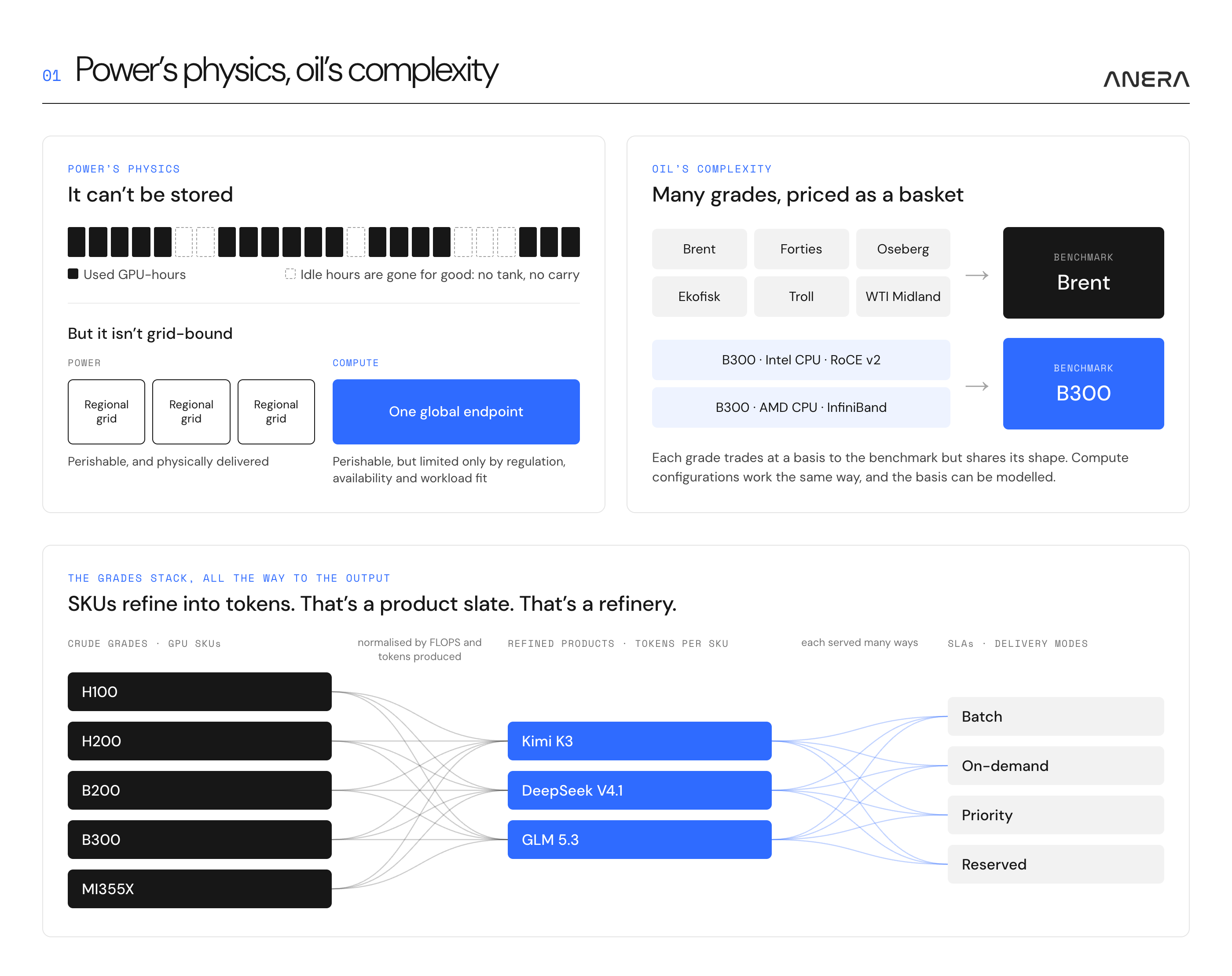
Fun fact: Brent isn’t a single grade of oil. It’s a basket of North Sea crudes: Brent, Forties, Oseberg, Ekofisk and Troll, and since 2023, WTI Midland too. Each trades at some basis to the benchmark, but they share its shape and characteristics. The same argument can be made for a B300 with an Intel CPU and RoCE v2 versus a B300 with an AMD CPU and InfiniBand. They’re largely similar, with some performance difference, and you can model that basis out.
And the grades stack, all the way to the output:
GPU SKUs: H100, H200, B200, B300, MI355X
Tokens per SKU: Kimi K3, DeepSeek V4.1, GLM 5.3
SLAs and delivery modes per token: batch, on-demand, priority, reserved
At the output level, there’s a ton of expressivity. You have tokens from different models, and then different delivery modes and SLAs for those specific tokens. A single model like Kimi K3 will have a fast endpoint, a batch endpoint, a normal endpoint, and so on, just at the token level. And you’re starting to see allied products sitting around these too.
So SKUs refine into tokens, and what you get is a broad GPU-hour-to-token complex that’s heterogeneous at both the input and the output level. That’s a product slate. That’s a refinery.
2. It’s bought like a commodity
Procurement is a forecasting problem, and it looks like power. As you get closer to understanding your traffic curve, the procurement book becomes an actively managed position across multiple strips, each one its own regime.
Three-year baseload offtake. This is your power purchase agreement, funded via project finance. It sets the direction of travel: how much demand you expect, how fast you expect it to grow, and how much capacity you proactively commit to. You size it on how quickly you’re growing and signing committed customers across different modalities of token serving, from serverless inference to post-training, sandboxes and higher-margin enterprise products. In essence, you price baseload off your ability to convert it into meaningful, predictable cash flows, whether that’s dedicated token serving or post-training.
Short-duration opportunistic capacity. More recently, this has become pretty valuable. The market for open-source inference has grown so much that people are trying to get their hands on any capacity they can to autoscale and serve more products. So anything available for less than three years, even month to month, gets taken. And you’re starting to see more equity and risk capital coming in to take on duration risk and maximise P&L. Since the token serving business is so profitable, there is a lot of demand for people that want compute, but dont have the capital or credit to get compute on longer duration. This opportunistic gap is being filled by compute commodity traders (arbitrageurs).
Day-ahead and forward capacity. The shorter tenors are getting interesting too. SF Compute is building something that looks like a primitive for forward capacity, which lets you start to dabble in actively managing capacity. Day-ahead should become a more important primitive as forecasting gets more precise and inference companies look to monetise idle time. It becomes meaningful when, say, an enterprise customer rolls off a contract, you’re facing one or two months of remarketing risk, and that capacity isn’t good enough to profitably serve serverless inference. You’d rather take it off your books.
Intraday. Then there’s the grid-style real-time market: the Nebius spot auction, National Compute by AMP , and other real-time load balancers that correct imbalances in compute estimation on or as close to t0 as possible. The intention here is pure necessity: either I need capacity at any cost, or I need it off my books because any money > idle time.
The PPA stays the PPA, and opportunistic capacity stays in its bucket. But long story short: you forecast your traffic curve far ahead, buy baseload against it, and trade the shape as you get closer. Anybody who’s run a power book will recognise this immediately.
3. It’s sold like a commodity
The other side of procurement is how compute is sold, and it’s basically a mirror image.
Baseload is sold first, at the project finance or PPA level.
Then come the microstructure specialists. SF Compute is building around forward capacity. Nebius, AMP and the like are building intraday load balancers.
And then the commodity traders, more opportunistically exploiting the term arbitrage. I can hold a three-year exposure, but there are many, many more buyers who can’t access or finance a three-year cluster. So I sell it to them at a premium on a shorter-duration curve.
Intraday: look at the Nebius spot auction for B300s. Over a single week, prices across eu-west2, uk-south1 and us-north1 move anywhere from roughly $1 to over $10 an hour. This is the same volatility we see in the intraday power markets.
You’re starting to see expressivity at every one of these layers, and functionally they look more and more like distinct regimes.
We’re in the earliest innings of procurement sophistication. There are plenty of researchers in power who have spent entire careers trying to tie the spot price of power to long-term prices and gotten nowhere. I suspect the same will happen in compute.
4. Participants behave like rational market participants
The token factory is the modern-day oil refinery. It runs a silicon spread business, and its business equation reduces to the difference between the revenue from tokens, the price per token less the GPU hourly cost. Over time, that GPU hourly cost will move to a net GPU hour cost, where you look to offload idle time.
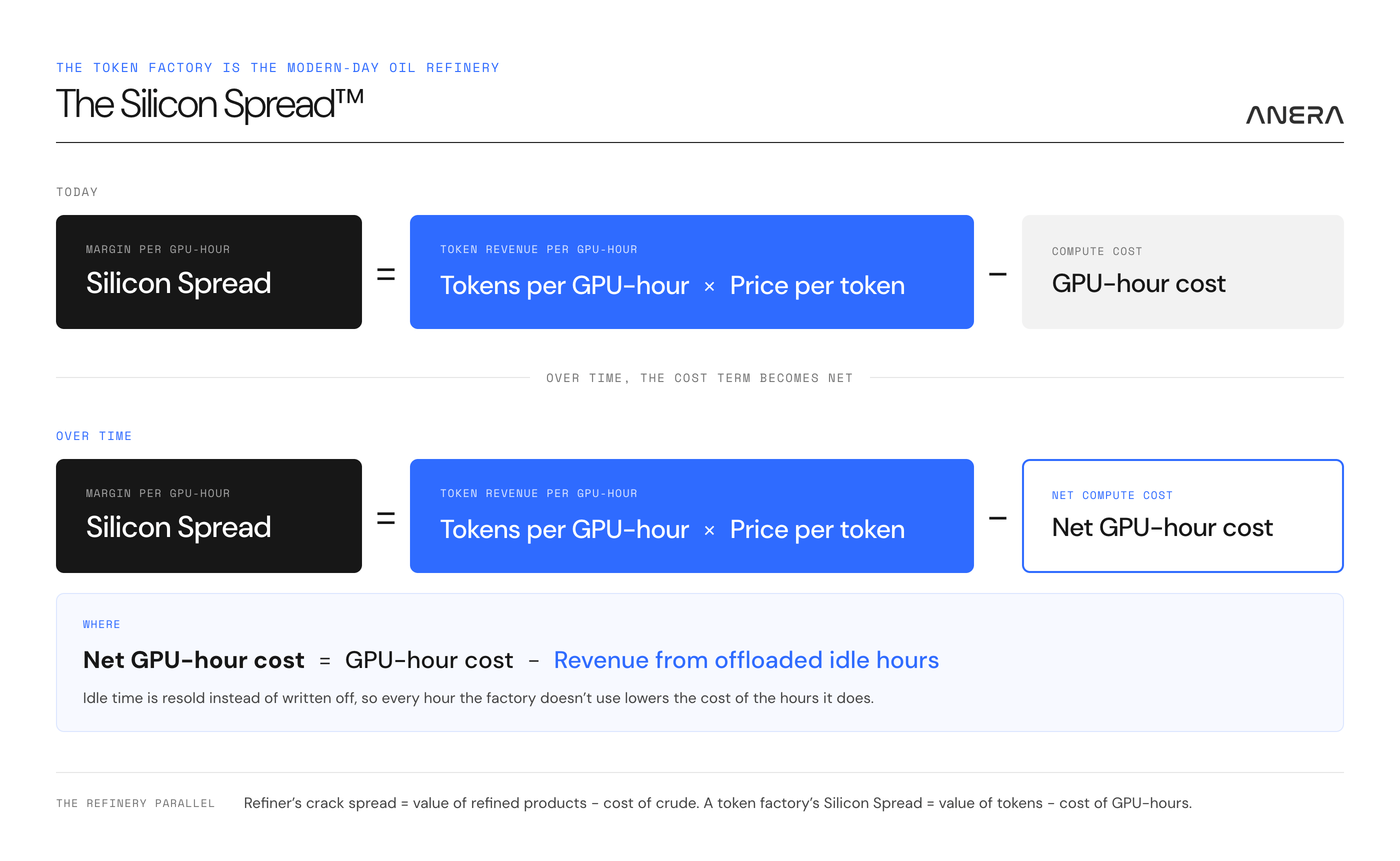
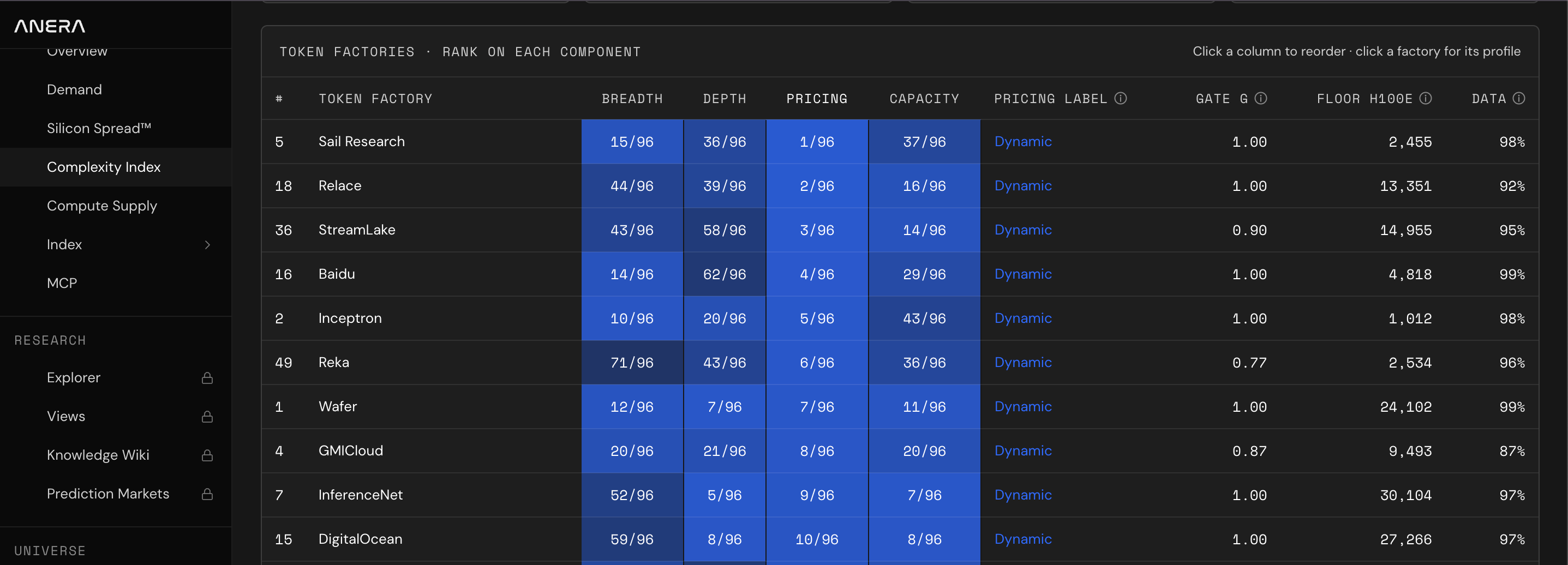
The goal is to maximise the spread. For a refiner in its earliest innings, the biggest lever is its own complexity: building out specialisation. We’re seeing this at the inference level too, across both breadth and depth. Companies are choosing to maximise for speed, or throughput, or product suite, or kernel engineering. Whatever it takes to build complexity, and ultimately efficiency, in converting GPU-hours into tokens as profitably as possible.
Ultimately, that complexity earns a token factory optionality. And this is the difference between where we are today and where we’ll be three years from now. It’s what I learned trading at the world’s most complex oil refinery: the complexity a refinery builds today buys the trading desk the optionality to internalise the spread tomorrow.
We had the highest Nelson complexity index of any refinery, so we could convert almost any crude, regardless of grade, into higher-margin refined products. When structural supply chain shortages made it harder for particular grades to reach the refineries that could only process that grade, the trading desk could take a view: flip that barrel to those refiners at a premium, and refine the inferior grades that only we could. That maximised the overall spread of the refinery.
We expect the same behaviour at the token factory level. Companies like Wafer, Inceptron or Sail Research who procure AMD compute, TPUs or other heterogeneous compute to produce Kimi K3 tokens, while 90% of other token factories are heavily reliant on NVIDIA and CUDA. So when there’s a B300 shortage and a premium for B300s at shorter duration, it’s not a stretch to imagine a token factory refining tokens on its AMD compute and reselling its B300s, maximising its margin. Thats what we are tracking with the Inference Complexity Index.
5. The compute commodity traders are here
There’s been a resurgence of compute commodity traders. Andromeda, Compute Desk, Jump and others are lining up to trade the curve. Not the forward curve, but the tenor curve. There’s so much scarcity at shorter duration that you want to take a three-year and sell it on shorter durations, internalising the spread.
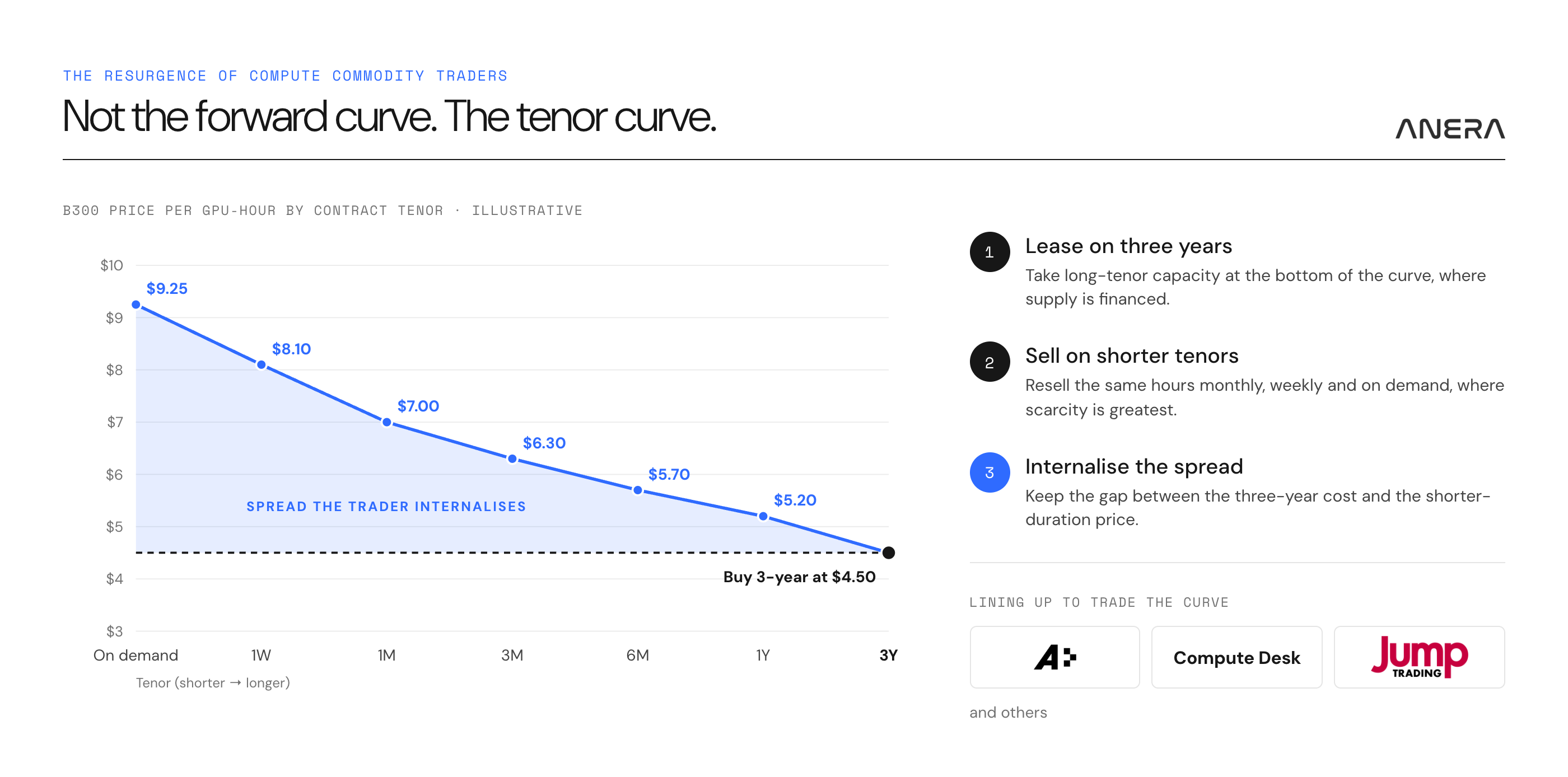
This is the natural functioning of a market. The appearance of risk-free money pulls in many players with independent balance sheets to exploit it. Spotting inefficiencies, scarcity and premia, and exploiting them, is critical to how any market works.
Today you can potentially internalise a 50% spread, and leverage is likely to enter, making it even larger. On the other side, many more arbitrageurs will enter and the arb will start to flatten. In theory, that means more liquid shorter-duration markets, and shorter-duration, opportunistic offtake becoming a much larger percentage of the overall fleet of a token factory.
And as the spread compresses, just as in oil, the commodity trader will have to become a refiner to find another way to capture a shrinking spread. Vitol and Trafigura bought refineries for exactly this reason. Our prediction: Andromeda will soon sell tokens.
Though to be fair, in the case of Vitol and Trafigura, the investment was usually more in midstream, to internalise the arb. Which leaves the open question: what is the midstream for compute?
No, compute isn’t a commodity
So far, we’ve made compelling arguments that compute exhibits strong commodity-like properties that resemble power and oil. But despite the commodity-like characteristics, adoption and behaviour, the harsh truth is that compute isn’t financed like one today, because it isn’t viewed as collateral. And the term curve is largely shaped by credit, not the actual asset.
It isn’t financed like one.
It isn’t viewed as collateral.
The term curve is shaped by credit, not the asset.
1. It isn’t financed like one
Senior lenders typically underwrite contracted cash flows and offtaker credit. Since these companies are NOT IG, the cluster project finance SPV’s require more equity. So prepayments emerged as a new mechanism to fill the hole left by the lack of counterparty credit.
What is a prepayment? A prepayment is large portion, typically 20-50% of the total contract value (on 3-5Y offtake) that is paid up front by a customer. This prepayment serves 2 purposes. Firstly, it makes up for the counterparties credit. Since these are non IG offtakers, the operator isolates the risk of offtaker default by slapping a large prepayment. Increasingly, the prepayment is credited against the back months of a contract. More importantly, the prepayment gives the operator interest free leverage to go and form the SPV that owns the cluster. A senior lender will typically give 70-80% of a clusters bill of materials and the operator needs to come up with their 20-30% + 3 months of DSCR. A prepayment allows them to kill 2 birds with 1 stone. Even if they do not capture a spread on the cluster for 3Y, they get a fully paid cluster at the end of year 3. Year 4 and beyond is pure profit. This also gives them an option on residual value.
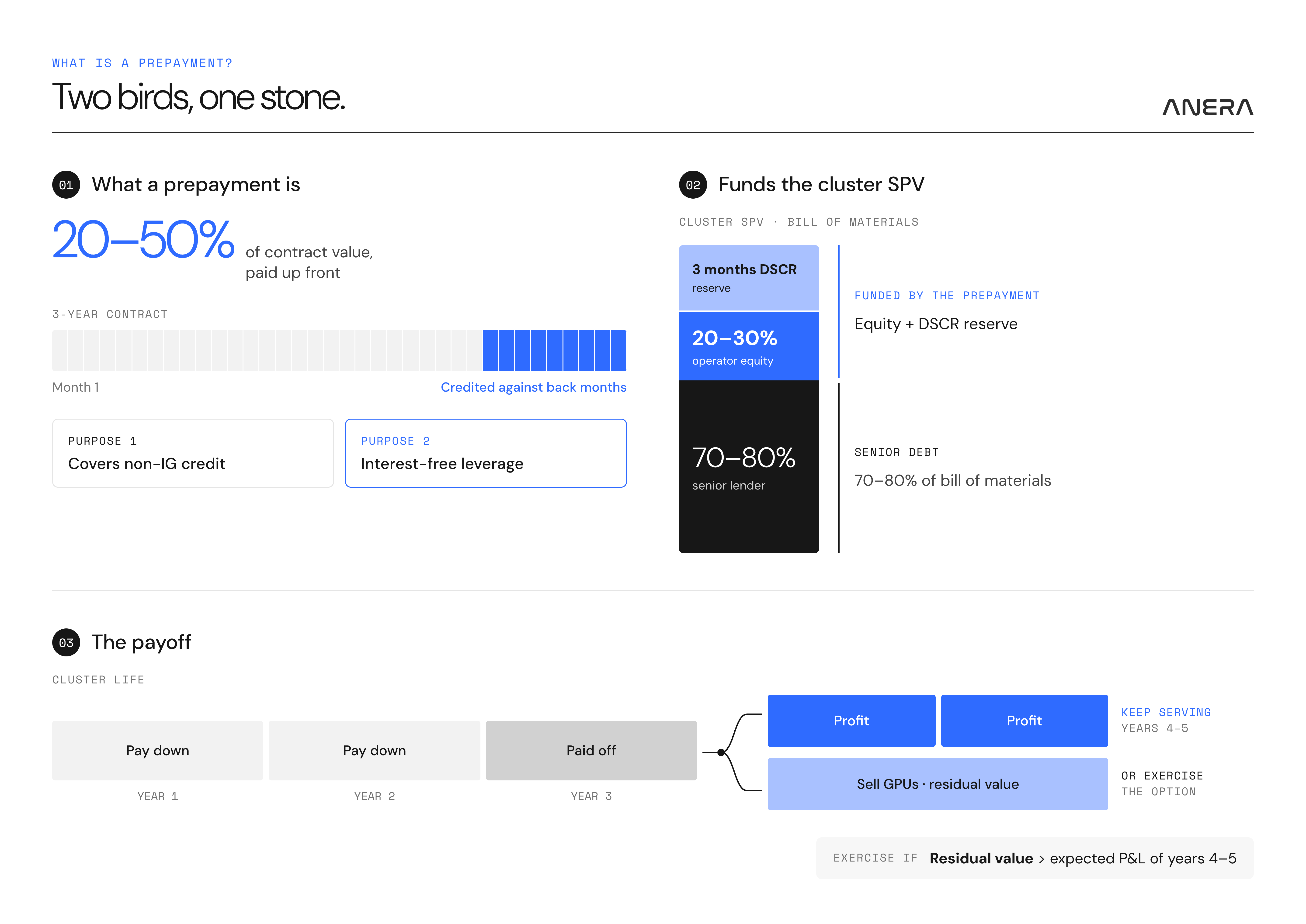
The offtaker today has no capital structure, other than massive equity funding. This is a massive gap.
2. Compute-hours aren’t viewed as collateral
Today, lenders take security over two things: the hardware and the contract. They lend against GPUs as depreciating equipment, and against the offtaker’s promise to pay. However, there is no waterfall for offtaker default. Since we are in the earliest innings of offtake exuberance, fuelled by venture dollars, this makes sense. However, this is not mature market functioning.
The problem I have with prepayments, other than them being a huge burden on the offtakers balance sheet, is that they completely ignore the collateral that sits under the whole lease. Today, the entire structure lives and dies on the offtakers ability to pay. This implies that the cluster/lease would be impossible to remarket if the offtaker were to default. Sure, the offtaker credit is important, but if an offtaker defaults, compute hours have a market too. They just aren’t treated as collateral yet.
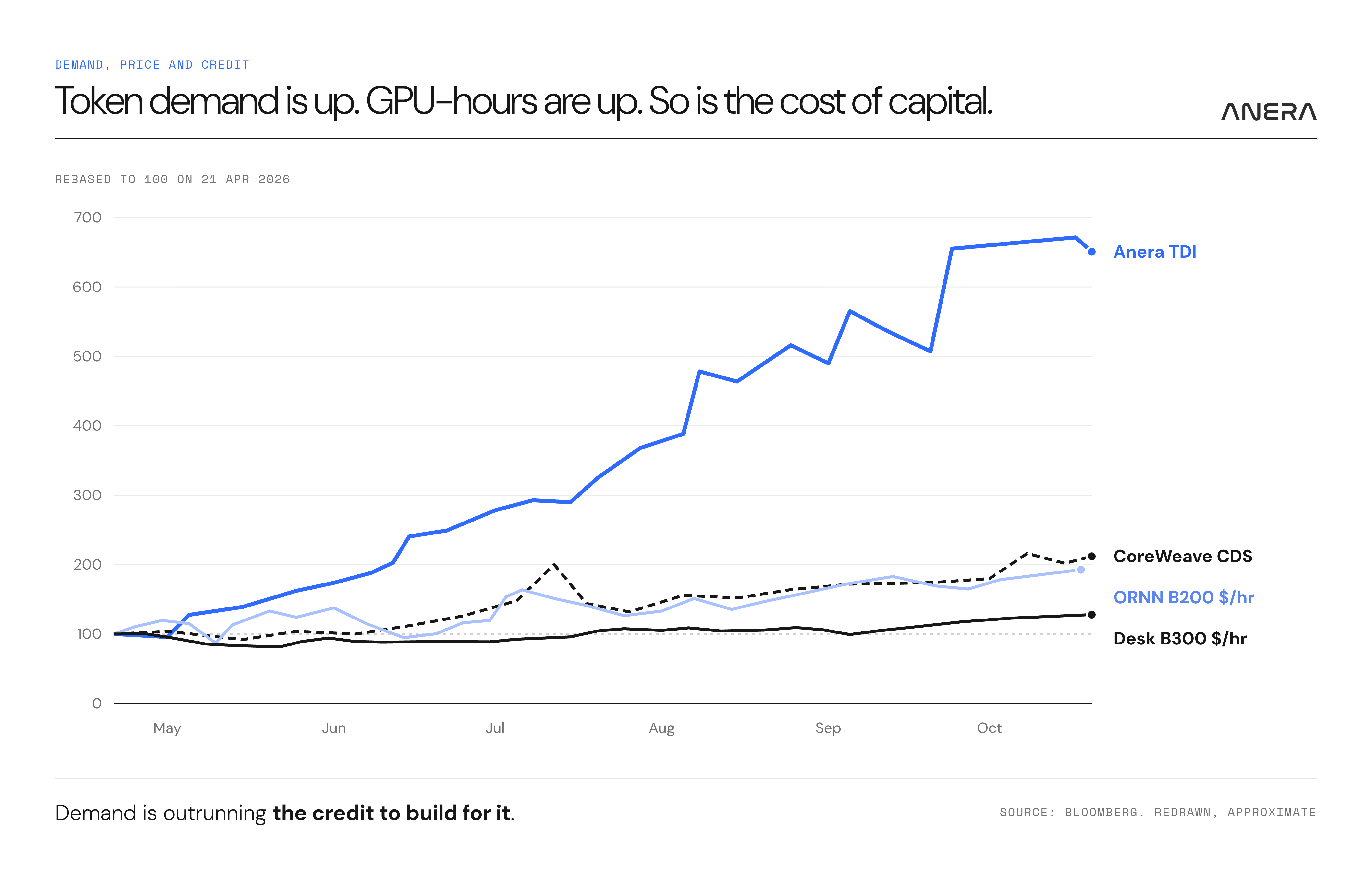
Here’s the interesting part. Because of the soaring demand for tokens, everything is up. GPU hourly prices, cost of capital and bond spreads. In trying to reason about this, one can only imagine that either the demand is a bubble, or the cost of capital is operator specific jitters.
3. The term curve is shaped by credit, not the asset
At the top, five years, you have the fewest creditworthy buyers. Then three years. That’s the line: senior lenders finance three years and up. Below it, at one year and down to spot, senior lenders don’t finance at all. And spot is where most of the buyers are.
So the term curve isn’t telling you what a GPU-hour is worth in three years. It’s telling you who’s creditworthy enough to sign for one.
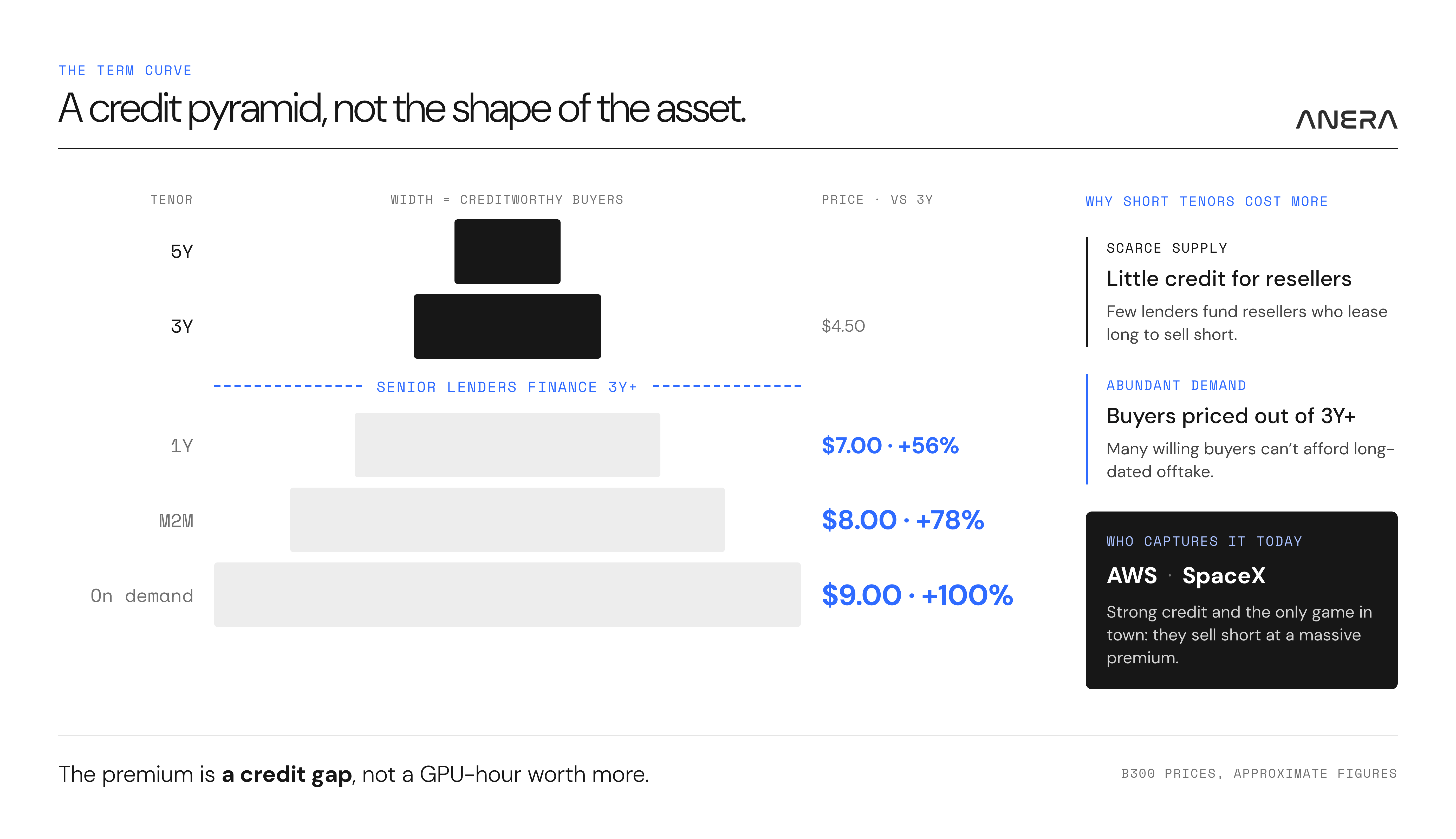
It literally comes down to how much balance sheet capital is available to build out more clusters. Sure, the curve is priced against availability and supply-demand dynamics. There is a reason why SpaceX and Elon are only selling 180 day contracts. It is because they have the credit to be able to do so. But the biggest driver of those supply-demand dynamics right now is credit, across the entire supply chain. The shape of the curve is a credit pyramid, not the shape of the underlying asset.
For compute to be a commodity, we have to finance it like one
Today, the prepayment is a gigantic commitment an offtaker makes in lieu of being investment grade. It puts a tremendous amount of pressure on a single counterparty, without ascribing any value to the underlying collateral.
The reality is that the GPU-hour is valuable regardless of the counterparty. In every other mature commodity market, you underwrite the collateral, not just the counterparty. There’s a mark-to-market value for the barrel, the reserves, the kilowatt-hour. For compute, that means underwriting the compute-hour, not just the counterparty.
Extending the ideas Jonah and Tarun brought up, the actual collateral here is access to the underlying lease. In a world where an offtaker defaults, that lease being transferable becomes an extremely important property.
What’s missing
Here’s what’s actually missing for compute to become a commodity and be financed like one:
Standardised offtake. Standardise what offtake agreements look like: their principal covenants, risks and rights.
Eliminate counterparty risk. Enhance every offtake with backup offtake, step-in rights and novation, assigned to a professional entity of risk transfer: a clearinghouse.
Mark the collateral to market every day, against a real price. A three-year lease might default at month 12, 18 or 24. Its value is what it can be resold for against the curve at that point.
Novate every physical offtake. In the event of default, there’s an orderly, centrally managed liquidation process for the capacity, instead of a bilateral scramble.
A clear default waterfall that isolates the risk from the operator, so lenders know exactly who loses what, in what order.
Every commodity market that broke on the counterparty, whether Chicago grain or Lehman, was solved by a centralised mechanism of risk transfer. In other words, a clearinghouse.
If that exists, offtake becomes self-liquidating
If a clearinghouse existed, offtake could become self-liquidating. You eliminate counterparty risk, and therefore make compute a commodity. That’s the essence of what’s missing.
Standardised, cleared offtake → collateral marked to market → self-liquidating finance → compute clusters get built around it.
The reality is that the credit ecosystem needs to evolve and sophisticate to make this happen. The psychological shift is away from the lender asking who the offtaker is, towards asking what the asset can reliably sell for, how fast, and who bears the risk. Those are exactly the questions a clearinghouse is designed to answer.
Over time, compute can do the same. With a real view on demand, on who needs which SKU, on remarketing time, and on utilisation across marketplaces, tenors and durations, you might even begin to finance clusters for sub-investment-grade offtakers, without exorbitantly large prepayments.
We’re building that entity
That’s our vision for Anera: the clearinghouse for compute.
We’ve seen the consequence of this not existing in the market for compute for open-source AI. It structurally puts the availability of compute to serve open-source AI at a massive disadvantage relative to the proprietary labs and hyperscalers.
We think the only version of the world in which open-source AI has enough compute infrastructure to power it is one where an entity rethinks how credit risk is shaped, away from counterparty risk. That’s what we’re building.
Compute borrows lessons from commodities like power and oil, but it also presents entirely new challenges. A rapid obsolescence curve makes compute structurally harder to mark to market, and harder to get a clear line of sight on what it’s worth. But if this were easy, anybody could do it.
We believe this has to be done, so that we’re not all slaves to Anthropic and OpenAI.
If you want a peek into how we underwrite the market, and want to access all of our data via MCP, here’s a special link to do so.
Thanks for reading Insights by Anera!